My Answers to Eight Questions スロバキアの雑誌の企画
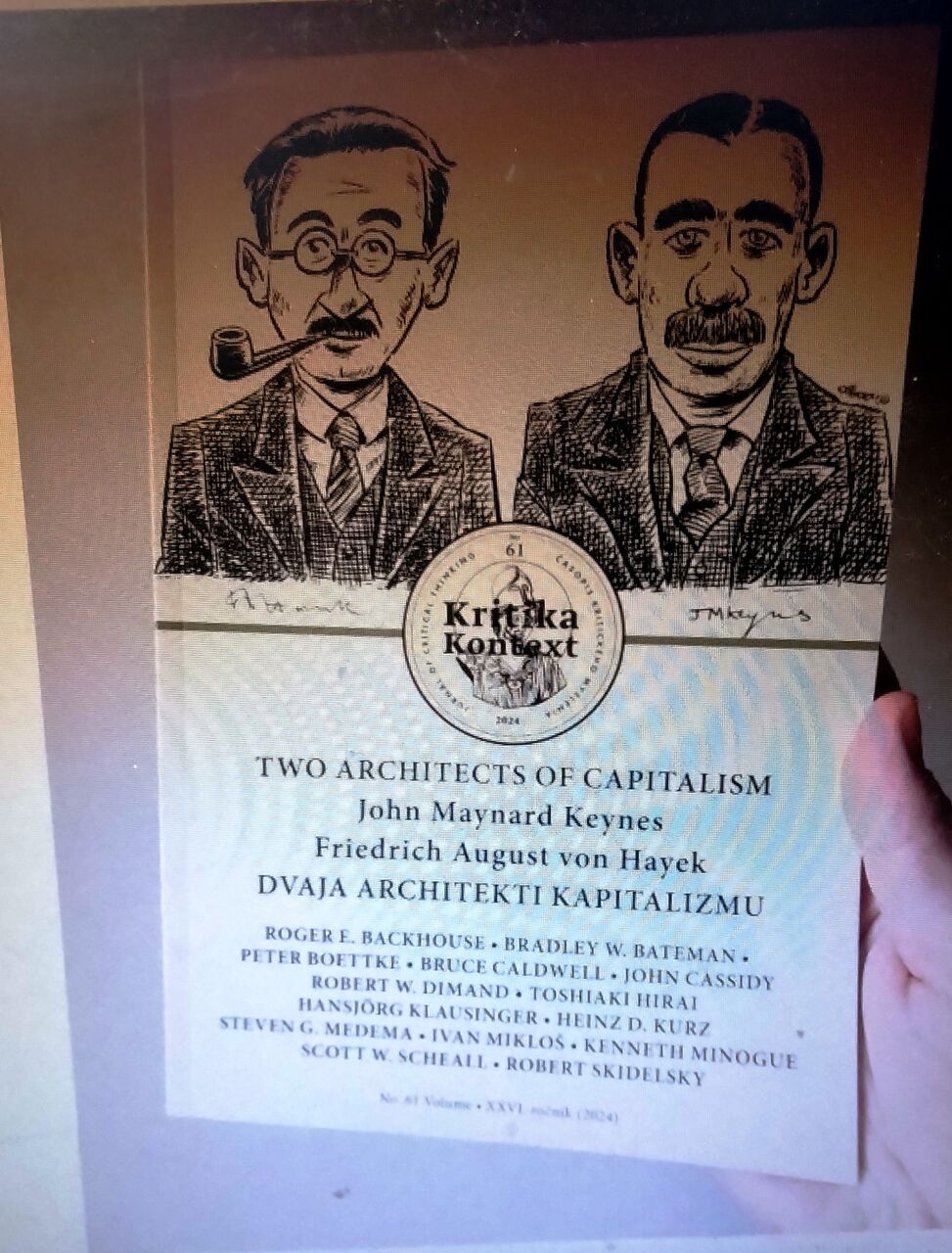
スロバキアの雑誌の企画でケインズとハイエクについて8つの質問が出されており、これに10名以上の研究者が回答を寄せる、というのがあった。私の回答は下記のものだが、このほど上記のような表紙の
かたちで雑誌になったことが編集者から届いた、という話。いずれ送付されてくることになっている・・・。 6月23日記
本日、スロヴァキアから上記の表紙の雑誌が届いた。
忘れた頃にやってきました、ケインズとハイエクが。
My Answers to Eight Questions
Toshiaki Hirai
Emeritus Prof., Sophia University, Tokyo
President of the Keynes Society Japan
Dec.19, 2022
Question 1
Ans.1
Influenced by the theory and policies of Keynes’s General Theory, various “Keynesian Schools” advocating a new theoretical and policy framework have emerged to deal with new economic problems since the end of WWII. To take a few examples, “the Income-Expenditure Keynesian School” (J. Hicks, D. Patinkin, J. Tobin),“the Disequilibrium Economic Keynesian School” (R. Clower, A. Leijonhufvud), “the Post Keynesian School” (P. Davidson, H. Minsky) and “the New Keynesian School” (N. Mankiw, J. Stiglitz, M. Woodford).
This phenomenon means that the various Keynesian Schools have developed different theories and economic policies, criticizing other Schools. It could even be said that disputes have occurred within the same School (One famous example is the dispute at the Post Keynesian Summer School held in Trieste, Italy, in the 1980s).
Considering the above, if we answer Question 1, it is fair to say that the phenomenon mentioned occurs mainly in the field of mass media. On the other hand, in the field of academia and policymakers, there are various “Keynesian Schools” based on the abovementioned development. In that sense, it can be said that Keynes’s influence has continued for a long time.
(We might add that Anti-Keynesian Schools have been popular at some point in time, such as “Monetarism” and “the New Classical Economics School.”)
Question 2
Ans.2
It can be said to be compatible with Hayek’s vision.
Would Hayek have questioned income inequality? Wouldn’t he have refused to allow the government to address income inequality?
Hayek’s vision consists of the view of market society and the “Theory of Spontaneous Order.” Individuals can only have on-site knowledge and information. What has been formed over time is a “Spontaneous Order,” a typical example of which is the price system. It must be treated as essential. Hayek would therefore disapprove of a policy of artificially correcting income inequalities in the price system.
It was the Obama administration that did the most to reduce income inequality. It argued: there are a massive number of Americans without health insurance coverage. The construction of a government-led safety net for them is essential in correcting the widening gap between the rich and the poor caused by excessive liberalization.
Many difficulties stood in the way of this realization, but in March 2010, the “Affordable Care Act” (the so-called Obamacare) was enacted.
This is in the Keynesian spirit. It is based on the same idea as the British “Beveridge Report (1942),” to which Keynes significantly contributed, assisting William Beveridge.
Question 3
Ans.3
I think Keynes does.
Keynes emphasizes two vital points in The General Theory in “The General Theory of Employment” (1937) - a reply to four articles focused on The General Theory.
One is to incorporate the reality that the future is filled with uncertainty, and the other is a presentation of the demand and supply theory of the output as a whole. The former is put forward in connection with his theory of the rate of interest and his theory of investment.
Hyman Minsky, who belongs to “the Post Keynesian School,” is famous for the “Financial Instability Hypothesis.” He develops the hypothesis, emphasizing Chapter 17, “The Essential Properties of Interest and Money,” of The General Theory. He also emphasizes portfolio selection, financial condition, and instability in investment, stating that an essential liquidity preference in the capitalistic economy lies in bankers and business people: It appears as the tendency of their balance sheets.
In contrast, the theory presented in Hayek’s Prices and Production (1931) argues that money affects relative prices, which lengthens [shortens] the production structure. It considers the impact of money on the real economy but does not address the issue of how money itself works in financial markets.
Question 4
Ans.4
It can be said that Hayek grasps the nature of the market society in three frameworks - economic agents with “on-site knowledge,” “the price system” with an information propagation function, and “competition” that functions as a driver of “unforeseen change.” As far as these points are concerned, His view of the market society is realistic.
On the other hand, the market society is conceptually constructed, an essential aspect of the “real” market society, such as the massive growth of Co., Ltd. and the increasing role of the state being abstracted. In this respect, Hayek’s view of the market society is an idealistic image extracted as “pure.”
Hayek regards the market society grasped this way as a representative example of “the Spontaneous Order” and defends it from this stance.
Thus, Hayek’s theory of market society is suspended “between realism and idealism.
In Prices and Production, Hayek argues that economic fluctuations are caused by changes in the production structure which occur by changes in relative prices.
However, it is unclear how he views the prices of stocks and bonds, for he does not explicitly explain the movement of those prices in his economic theory.
Question 5
Ans.5
It is the Bush Republican government that was deeply involved in the “Lehman Shock”. Financial liberalization went far to progress the so-called “multi-layered securitized products.” As a result, the Lehman Shock finally occurred due to the collapse of the subprime loan, which brought about a chain of financial failure of major commercial banks and investment banks.
Keynesian thinking does not reveal naivety. It was “the New Keynesian School” under the Obama Democratic Administration that promoted Keynesian economic policies to deal with the Lehman Shock.
Obama enacted the American Recovery and Reinvestment Act [ARRA] in February 2009. It was an essential policy with a full scale of 787 billion dollars over two years to recover the American economy.
A significant feature of the ARRA was the revival of fiscal policy, which had hitherto been sealed as an economic stimulus, as an employment policy on a large scale (associated with an infrastructure development and an environmental policy). Economists and economic policymakers had been of the dominant view that interest rate policies (especially the FF interest rate guidance policy. See “Greenspan Magic”) were sufficient for economic adjustment, and few had advocated fiscal policy.
(With the midterm election defeat, Obama’s fiscal policy ended inadequately.)
Question 6
Ans.6
If I were to be asked, “Have not philosophical considerations fully grasped capitalism?” I would answer, “There exists some social philosophy underlying economics.”
In the case of Keynes’s New Liberalism, the emphasis is on economic efficiency, social justice, and individual liberty. The final chapter of The General Theory deals with “social philosophy.”
Besides Keynes, Cambridge School economists – such as R. Hawtrey (supremacy of Socialism over Capitalism), D.H. Robertson (“Liberal Interventionism”), and A.C. Pigou (supremacy of Socialism over Capitalism) – also developed their own social philosophies.
Hayek’s social philosophy is “the Theory of Spontaneous Order.” He developed his social philosophy by fighting two enemies - external and internal. The former was what Hayek called “Constructivist Rationalism,” and he developed a fierce criticism from the viewpoint of his liberal thought (including not only pure Constructivist Rationalists such as Saint-Simon, A. Comte, and K. Marx but also Keynes, J. Schumpeter, and G. Myrdal). The latter was the market society view of Walrasian economics, and he continued to sound alarm bells from the viewpoint of the Austrian School. Hayek’s unique liberal philosophy underlies this two-way battle.
When conceiving an economic theory, what kind of social philosophy should be embraced is crucially important.
Question 7
Ans.7
Hayek’s view of the individual and the theory of the Spontaneous Order vs. Keynes’s New Liberalism of the individual and social organization: Keynes seems more realistic than Hayek.
It is necessary to point out the difference by referring to the characteristics of the two social philosophers. The following point expresses it well.
Hayek, in The Road to Serfdom (1944), criticized not only Nazism and Socialism but also Keynes’s stance, stating that they would lead to the road to serfdom. After reading the book, Keynes wrote to Hayek, “you greatly underestimate the practicability of the middle course. … you are trying to persuade us that so soon as one moves an inch in the planned direction you are necessarily launched on the slippery path which will lead you in due course over the precipice (sic).”
Keynes instead thinks that an ideal organization should be somewhere between the individual and the state, and highly appreciates the development of organizations that have been produced as a result of the historical progress of the market society, such as the growth of “semi-autonomous bodies within the State” and the “tendency of big enterprise to socialise itself (sic).”
Question 8
Ans.8
Hayek was suspicious of the government’s activities. He saw the economy from the perspective of governments and institutions becoming oversized and distorting the price system. In other words, the perspective of the government’s response was lacking from the beginning.
On the other hand, Keynes worked tirelessly to solve many challenging problems during WWII, such as the lend-lease problem, the commodity problem, the international monetary system (International Clearing Union), the reparations problem, and the social security problem.
Regarding the Covid-19 pandemic, each country has taken various measures to prevent its spread (vaccination, travel restrictions, and business restrictions in the service industry), which have caused an increase in unemployment and a sharp decline in the real estate sector (among others, in China and South Korea).
Moreover, the Ukrainian War has posed a severe problem. Inflation due to a sharp decline in the supply of wheat and petroleum has attacked the world. We might also mention the FRB’s continuous rise in the policy interest rate. Thus the world has suffered from great Stagflation.
The story does not stop here. Russia has continued to suffer from a hefty defeat, making its geopolitical position in the world very vulnerable.

コメント
コメントを投稿